CRM, inbox, database, forms, internal APIs.
VFSYSTEM CONTROL PLANEAI operations,
AI operations,
built like
infrastructure.
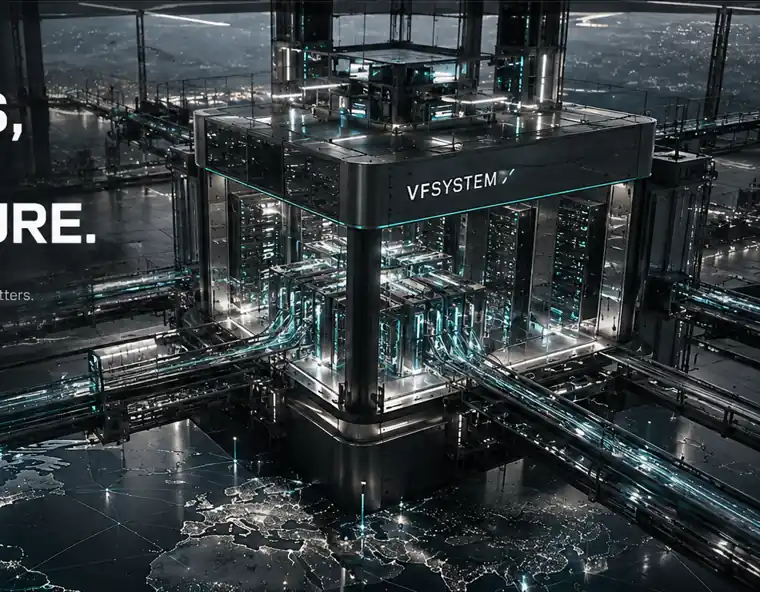
We design, deploy and operate AI systems that connect data, decisions and actions — with human control where it matters.
CONTROL PLANE / 001DATA → DECISIONS → ACTIONSGLOBAL DELIVERY · HUMAN CONTROL BY DESIGN
01 / CONTEXT02 / POLICY03 / AGENTS04 / EXECUTION05 / AUDIT
SYSTEM / 01
Not another AI layer.
An operating layer.
Models are replaceable. The hard part is connecting them to business context, permissions, people and real actions without losing control. That is the system we build.
VFSYSTEM / REFERENCE ARCHITECTUREPRODUCTION CONTROL PATH
History, records, documents and current workflow state.
Role-specific agents choose the next permitted step.
Risk boundaries, approvals and exception handling.
Update, send, create, route, notify, call an API.
AUDIT BUS
event.received → context.loaded → policy.checked → action.proposed → approval → execution → verificationFLAGSHIP ENGAGEMENTAI OPERATIONS BUILD
One expensive workflow.
Rebuilt as a production system.
We start where manual work has a real operating cost. The build covers the workflow, integrations, control boundaries, failure handling and production handoff — not just a prompt or chatbot.
ENTRYWorkflow teardown
SCOPEOne measurable process
DELIVERYTypically 4–8 weeks
BUILDFrom $15k
SOLUTIONS / 02
Where the control plane earns its keep.
REVENUE OPERATIONS
Turn account research and sales operations into an operating system.
Connect signals, company context, qualification rules, outreach preparation and CRM actions into one controlled workflow.
01SIGNAL02CONTEXT03QUALIFY04HUMAN GATE05ACTION
INTERNAL OPERATIONS
Remove the handoffs that live between people and disconnected tools.
Requests, approvals, enrichment, document work, reporting and system updates become traceable execution paths instead of manual coordination.
01REQUEST02DATA03POLICY04DECISION05EXECUTE
CUSTOMER OPERATIONS
Give service teams context before asking them to make another decision.
AI gathers history, classifies intent, drafts or executes permitted actions and escalates the cases that actually need a person.
01INBOUND02HISTORY03ROUTE04RESPOND05ESCALATE
CONTROL / 03
Autonomy without boundaries is not infrastructure.
Production automation needs a defined blast radius. Every system is designed around explicit permissions, review points and traceability.
Inspect our internal reference build ↗Agents only receive the tools and actions required for their role.
Sensitive or ambiguous actions stop for explicit review.
Execution states, failures and retries remain visible.
Important actions can be traced back to context and policy.
ENGINEERING PROOF / 04
We built the control pattern before putting it in the pitch.
Our internal Revenue Engine uses persistent task state, research and qualification stages, explicit approval before outbound actions, bounded follow-ups and reply-aware cancellation.
We publish the implementation status as engineering proof. It is not presented as a client case study and we do not manufacture performance numbers.
Open reference build ↗APPROACH / 05Find the constraint.
Find the constraint.
Build the system.
Operate what works.
Diagnose
Map the current workflow, economics, source data, systems and failure points.
WORKFLOW TEARDOWN → SYSTEMS AUDITEngineer
Build integrations, state, agent roles, policy, approvals, retries and observability.
PRODUCTION IMPLEMENTATIONOperate
Watch production behavior, resolve exceptions and expand only when the economics justify it.
MANAGED AI OPERATIONSPROJECT TERMS
Project scope and price are fixed in USD. Settlement is made in USDT or USDC on the agreed network. Managed operation is optional after launch.
Discuss a workflow ↗ START WITH THE WORKFLOW
Show us what your team should not be doing manually.
Send the current process, systems involved and the outcome you want. The first conversation is about whether the workflow is worth automating.